How I Tried to Grow on Social Media by Posting Daily (and Why Quote Cards Won)
Our founder wanted to grow his social media by posting every day. Most formats broke the habit. One format, the quote card, made daily posting easy enough to keep.

On this page 22 sections
- The plan: post every single day
- What actually broke the streak
- Why posting daily still matters
- More posts, faster growth
- More posts, more reach per post
- Your audience is already there every day
- The turning point: one sentence is enough
- What is a quote card?
- Why quote cards made the daily habit stick
- The idea is the whole post
- One card works on every platform
- Your face builds recognition
- It survives busy days
- What changed after the switch
- One card, five posts
- How to know if daily posting is working
- From a personal habit to SaidCard
- How to post daily with quote cards: a simple plan
- What to post: 12 sentence prompts
- Mistakes that break a daily posting habit
- Conclusion
- Sources
Our founder had a simple goal. He wanted to grow his social media handles, and every expert said the same thing: post daily on social media and the growth will come. So he tried. And for weeks, the plan kept falling apart by Wednesday.
This is the story of what broke, what finally worked, and why that one format became SaidCard. If you have ever promised yourself you would post every day and then disappeared for two weeks, this one is for you.
The plan: post every single day
The plan looked easy on paper. One post a day, on every platform, for a whole quarter. He had years of lessons from teaching, building websites and running events, so ideas were never the problem.
The problem was everything that came after the idea. A carousel needed a design. A video needed lighting, a script and editing. A long text post needed a different version for each platform. By the third day, one post was eating an entire evening.
What actually broke the streak
- Design time. Opening a design app, finding a template and fixing the spacing took longer than writing the idea.
- Platform sizes. A square for Instagram looked wrong on X, and a wide image got cropped on a status.
- Perfection. When a post takes an hour, it feels like it has to be perfect, so it never ships.
- Busy days. One meeting heavy day was enough to break the chain, and a broken chain is hard to restart.
Why posting daily still matters
The streak kept breaking, but the strategy was right. The data says frequency really does move the numbers.
More posts, faster growth
Buffer studied about 2.1 million Instagram posts from roughly 102,000 accounts. Accounts posting 1 to 2 times a week grew followers by about 0.12% a week. At 3 to 5 posts it was 0.26%, at 6 to 9 posts 0.44%, and at 10 or more posts 0.66%.
More posts, more reach per post
The same study found each post reached more people as frequency went up. Compared with 1 to 2 posts a week, reach per post was about 12% higher at 3 to 5 posts and about 24% higher at 10 or more.
Your audience is already there every day
Pew Research Center reports that 84% of U.S. adults use YouTube, 71% use Facebook and 50% use Instagram. Your people are scrolling daily. The only question is whether you show up in that scroll.
The turning point: one sentence is enough
The breakthrough came from looking at which posts he actually finished. The ones that shipped every time were the simplest: one strong sentence, his name and face, and a clean background. They looked like a screenshot of a great post.
Those were quote cards. They took a minute to make, they read in two seconds, and people saved and shared them more than anything that had taken an hour.
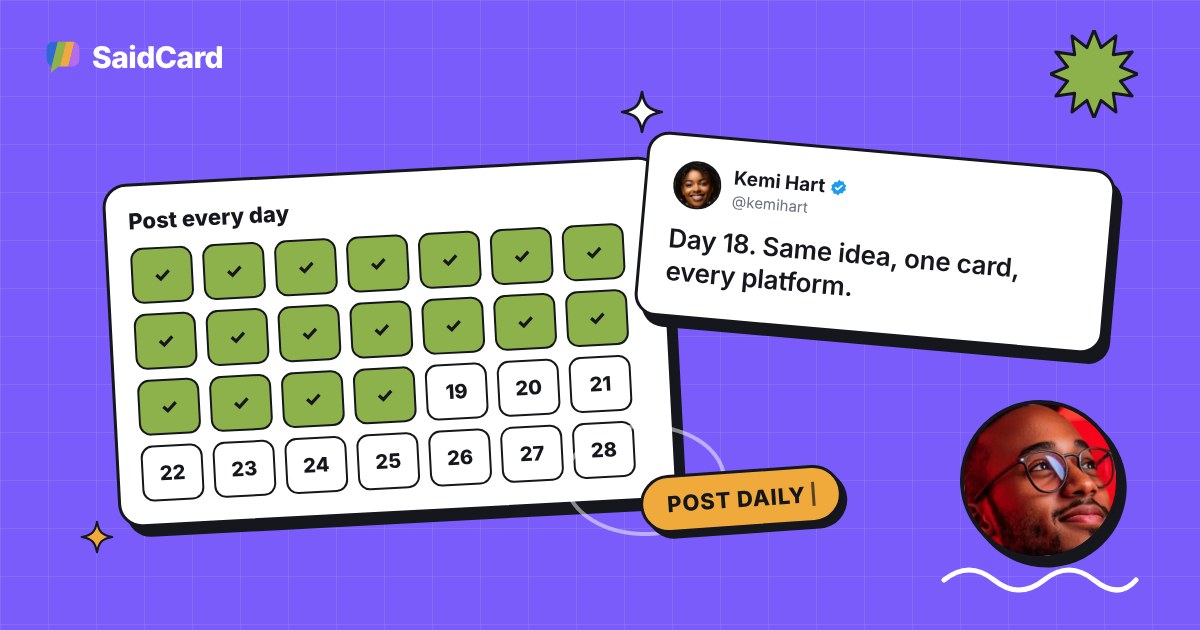
Day 18. Same idea, one card, every platform.
Make this a quote card
What is a quote card?
A quote card is an image that shows one short statement with the name, handle and photo of the person who said it, styled like a social media post. It turns a thought into something people can read in a glance, screenshot and pass on.

Why quote cards made the daily habit stick
The idea is the whole post
With a quote card, the writing is the work. There is no editing timeline and no slide deck. If you have a sentence worth saying, you already have a post.
One card works on every platform
The same sentence can be downloaded as a square for Instagram, a wide card for X and LinkedIn, and a tall card for TikTok, Facebook stories and WhatsApp status. One idea becomes five posts.
Your face builds recognition
Because the card carries your name and photo, every share is a small introduction. People start to recognise your face before they know your work.
It survives busy days
On a full day you can still make a card between meetings. That is the real secret of daily posting: the format has to be easy enough for your worst day, not your best one.
What changed after the switch
The biggest change was not a number. It was that posting stopped feeling like a project. A sentence written on the bus in the morning could be a finished post before the first meeting of the day.
Because each card took a minute, there was no pressure for every post to be perfect. Some cards did well and some did not, but the streak kept going, and a streak is what gives the algorithm and your audience something to learn from.
People also started to recognise the look. Using the same style with the same face meant a card was familiar before anyone read the name. That kind of recognition is hard to buy and easy to build when you show up daily.
One card, five posts
The other surprise was how far one sentence could go. A single idea, made once, covered every platform for the day.
| Platform | Card size | How to post it |
|---|---|---|
| X | Wide, 1200 by 675 | Card plus a one line reply asking for opinions |
| Wide or square | Card plus a short story behind the sentence | |
| Portrait, 1080 by 1350 | Feed post with a question in the caption | |
| Square or portrait | Card shared to your page and relevant groups | |
| TikTok and status | Tall, 1080 by 1920 | Photo post or status with a short caption |
How to know if daily posting is working
Followers are a slow signal. Watch the numbers that move first, and check them once a week rather than every hour.
- Saves and shares. These show a sentence was worth keeping or passing on.
- Profile visits. A card that sends people to your profile is doing its job.
- Replies. Comments tell you which ideas people want to talk about.
- Your own consistency. Count the days you posted. If it is 25 out of 30, the habit is winning.
Every Sunday, look at your top three cards of the week and write three new sentences in the same spirit. That loop is how a daily habit gets sharper over time.
From a personal habit to SaidCard
Once the habit worked, the tooling became the next problem. Most tools could make one platform’s style, not all of them, and many added watermarks. So we built the tool we wanted: type one sentence, add your name and photo, and download a card sized for every platform.
That tool became SaidCard. In our first week of launch, people downloaded almost 1,000 cards. Every one of those was somebody keeping a posting habit alive.
How to post daily with quote cards: a simple plan
How to post daily on social media with quote cards
A simple routine to publish one quote card every day.
Time needed: 5 minutes
- Collect sentences
Keep a note on your phone. Save one line a day from your work, your reading or a conversation.
- Batch on Sunday
Spend 20 minutes making seven cards for the week ahead.
- Use one look per week
Pick a single look so your feed looks consistent and you make fewer decisions.
- Download every size
Save the square, wide and tall versions of each card so every platform is covered.
- Post at the same time daily
Choose a time you can keep, such as before work, and post the day’s card.
- Reply to every comment
Spend five minutes answering people. That turns reach into relationships.
What to post: 12 sentence prompts
Running out of ideas is rarely the real problem, but prompts make the first sentence easier. Finish any of these with your own experience and you have a card.
- The best advice I ignored for too long was...
- Most people get this wrong about my work...
- A small habit that changed my year...
- If I started again today, I would...
- The question clients ask me most is...
- One thing I stopped doing this year...
- A mistake that taught me more than a win...
- What nobody tells beginners in my field...
- The simplest tool I use every day...
- I changed my mind about...
- Here is what progress actually looks like...
- The one sentence I would tell my younger self...
Mistakes that break a daily posting habit
- Waiting for a perfect idea. A good sentence today beats a perfect one next month.
- Changing your look every day. Consistency helps people recognise you.
- Writing paragraphs on a card. If it needs a second read, cut it.
- Posting and leaving. Growth comes from the conversation after the post.
- Quitting after a missed day. Miss one day, never two.
Conclusion
Posting daily on social media works, but only with a format that fits a real life. For our founder, that format was the quote card: one sentence, his name and face, and every platform covered in a minute.
If your streak keeps breaking, do not post less. Make each post easier. Open SaidCard, write today’s sentence and download it for every platform, or start from a look like Repost Card.
Frequently asked questions
Is posting every day on social media good?
Yes, if you can keep the quality up. Buffer’s study of 2.1 million Instagram posts found follower growth and reach per post both rise as weekly posting goes up.
What should I post every day if I run out of ideas?
Post one sentence from your work: a lesson, an opinion, a mistake you fixed or a question you hear often. A quote card turns each one into a post.
How do I make a quote card?
Type your sentence in a quote card maker, add your name, handle and photo, choose a look and download the size for your platform.
Can I use the same quote card on every platform?
Yes. Download the square, wide and tall versions of the same card so it fits Instagram, X, LinkedIn, Facebook, TikTok and status updates.